HOI AN ON BIKE

Once known as Faifo, Hoi An was one of the orient's major trading ports in the 16th and 17th centuries.

Hoi An City Tours

Take a step back in time on a walking city tour of Hoi An -a well-known ancient town in Vietnam and a UNESCO World heritage site. A private guide leads you through the well-kept historic district of this once-prosperous seaport city.

Nha Trang Boat trip

Overview Transferring to Da Chong Whalf, about 18 km away from the city center for embarking on boat, cruising on Nha Phu bay.

Ha Long bay

Recognized by Unesco as a World Heritage Site since 1994 for it thousands of natural islands, Ha Long Bay is a legendary world, and one of the most magnificent scenic spots in Vietnam as well.

Discover Stunning Terraced fields in Northwest Vietnam

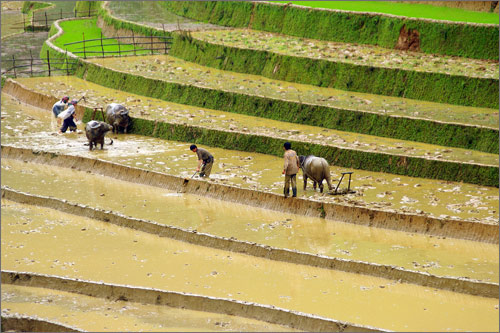
The terraced fields in the mountain district of Mu Cang Chai in Yen Bai, Vietnam are associated with the developmental history of the Mong ethnic minority group.

Da Lat’s take on terraced fields

Visitors to Dalat City in southern Vietnam will find transfixing views of terraced fields which will bring to mind the mountainous Northwest.

Travelling around the outskirts of Da Lat, tourists can enjoy viewing terraced fields of vegetables and flowers, like the work of an artist.

In Da Lat, terraced fields surround small houses and winding roads curve around wooded hills, creating a romantic and peaceful space.

Many local vegetable and flower growers say Da Lat’s terraced fields have their own special beauty. They are most beautiful in the morning sunlight.

Some photos of Da Lat terraced fields:

Despite not being as famous as terraced fields in the Northwest, Da Lat fields have their own unique beauty

Vegetables are mostly grown in the fields, along with flowers

Terraced fields surround houses

You can see terraced fields from the surburban outskirts

Terraced fields besides pine tree-covered hills

Valley of terraced fields

Curving terraced fields look like artistic creations

An extremely peaceful and poetic space

Quiet delights of Cu Lao Cham

The beaches and attractive landscapes of Cu Lao Cham in Quang Nam Province are a draw for travellers.

The island in Tan Diep Commune in Hoi An has been recognised by UNESCO as World’s Biosphere Reserve. It boasts several relics from diverse and ancient cultures, such as Sa Huynh, Cham Pa and Dai Viet.

Arriving in Cu Lao Cham in the early morning is a rare delight, giving the visitor a chance to see the dawn’s glow from serene beaches.

Blue, clear and isolated coastline, such as Ong and Huong, are ideal destinations for holidays. The sea takes on a special sparkle at sunrise and sunset.

Visitors’ first impressions may be the warm smile and hospitality of the locals.

This is a fishing town, and fresh fish can be found in the area markets.

In addition, this is one of the few areas in Vietnam where Cham people can still be found.

Hai Tang Pagoda, built more than 400 years ago, adds to the town’s rare atmosphere. Burning a few sticks of incense and walking around the town may renew your senses and give you a bit of respite from the noise and fury of every day life.

At night, the silence of Cu Lao Cham is quite noticeable, compared to the busy streets of big cities. The only sounds are made by the waves crashing into the shore.

Peaceful beaches

An ancient well

Holy pagoda

An intimate sunrise

Queen Mary brings tourists to Nha Trang

The world’s largest cruise liner, Queen Mary 2, with over 2,430 tourists aboard, visited Nha Trang Bay in the central province of Khanh Hoa on March 21.

The tourists, mostly from the United Kingdom, Australia, the United States and Canada, visited scenic and relic sites as well as enjoying special dishes and shopping in the locality.

On the afternoon of the same day, the cruise liner left Nha Trang Bay and sailed to Thailand.

Statistics from Khanh Hoa tourism sector show that in the first three months of this year, Nha Trang Bay welcomed 13,000 arrivals on 12 international cruise liners.

(Source: VNA)

Soc Trang Clay Pagoda recognised as a cultural relic

A pagoda known for its clay Buddha statues has been recognized as a historical and cultural relic of the Mekong Delta Province of Soc Trang.

The pagoda's original name was Buu Son Tu, but pilgrims usually call it Chua Dat Set (Clay Pagoda). Built by the Ngo family more than 200 years ago, the pagoda is now run by members of the family's fourth generation.

Visitors to the Clay Pagoda can see 1,800 small and large Buddha statues and a great number of prayer objects made of clay. The pagoda is also well-known for having four pairs of giant candles that weigh 200kg each. They are 2.6m high, with a diameter of one meter.

The candles were made in 1940. Two of the candles have burned continuously since the death of head priest of the pagoda, Ngo Kim Tong, in 1970, and have burned off only half the wax.

(source: VNS)

Cambodian harvesters in Mekong Delta

If you have a chance to visit Dong Thap Muoi region in the southern Long An province during the harvesting season, you will be able to enjoy the limitless expanses of paddy fields dotted here and there with Cambodian farmers.

Since there is a shortage of local harvesters during the season, local people have to turn to hiring Cambodian workers to help them do field work like digging, spraying fertilizers, and harvesting rice.

Many poor Cambodia laborers often cross the border to Vietnam’s Dong Thap Muoi region to earn a living to feed their families at home.

Following are some photos by Tuoi Tre:

Cambodian workers

Despite hard work, they always wear radiant smiles

Cambodian workers

Cambodian workers flocking to paddy fields in Vietnam from Cambodia

Cambodian workers

At around 6:30 am everyday, Cambodians present themselves at the border post in Vinh Hung district, Long An province to undertake immigration procedures to apply for jobs in Vietnam

Cambodian workers

The man in this photo is anxiously waiting for a job in Vietnam. Some even have to wait from early mornings till afternoons on a daily basis to get hired by a Vietnamese boss

Cambodian workers

Hai Don, a Vietnamese rice landowner, is happy to pick up familiar workers over the border. Today, she needs five laborers for her rice field

Cambodian workers

Hai Don entrusts strong male workers with the task of mixing fertilizer

Cambodian workers

Cambodian workers begin a new working day by transferring fertilizers to rice fields, a couple of kilometers away from their houses

Cambodian workers

Despite unfavorable weather conditions, the female workers take a short nap, and have lunch and breakfast on field site

Cambodian workers

They leave their shoes on the edge of the rice field. They have to cross dozens of kilometers to head towards Vietnam wearing these thin shoes

Cambodian workers

They are carrying bags of fertilizers towards the rice field

Cambodian workers

Both employer and employees are enjoying an informal lunch

Cambodian workers

After a hardworking day, this woman brought to her house in Cambodia only some sundries she bought from a market near the border

It’s very easy to recognize the close relationship between and Vietnamese owners and Cambodian workers. They treat one another like good friends.

Local rice field owners told Tuoi Tre that Cambodian laborers work very hard and well, adding they are willing to do all the hard work.

Meanwhile, according to Cambodian workers, Vietnamese employers are very kind.


TEXT LINK:
tải game điện thoại - Agents for modeling - Gai xinh - Visa Vietnam - Vietnam Express Visa - Teen Teen - Tai iOnline Mien Phi - Game Java