HOI AN ON BIKE

Once known as Faifo, Hoi An was one of the orient's major trading ports in the 16th and 17th centuries.

Hoi An City Tours

Take a step back in time on a walking city tour of Hoi An -a well-known ancient town in Vietnam and a UNESCO World heritage site. A private guide leads you through the well-kept historic district of this once-prosperous seaport city.

Nha Trang Boat trip

Overview Transferring to Da Chong Whalf, about 18 km away from the city center for embarking on boat, cruising on Nha Phu bay.

Ha Long bay

Recognized by Unesco as a World Heritage Site since 1994 for it thousands of natural islands, Ha Long Bay is a legendary world, and one of the most magnificent scenic spots in Vietnam as well.

Discover Stunning Terraced fields in Northwest Vietnam

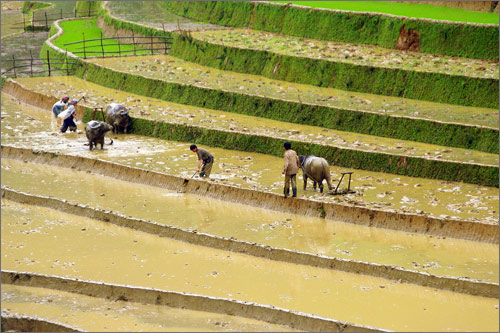
The terraced fields in the mountain district of Mu Cang Chai in Yen Bai, Vietnam are associated with the developmental history of the Mong ethnic minority group.

Italian architects help preserve Hanoi’s old quarter

The Italian embassy in Vietnam and the Genoa Architects Association held a conference in Hanoi on June 3 to introduce Genoa’s experience in preserving its old city after it was recognised by UNESCO as World Heritage site.

The event, one of the activities to mark Italy Independence Day (June 2), said the Italian ambassador, Lorenzo Angeloni.

Architecture is one of the major issues of concern for the Italian embassy in Vietnam. The Genoa Architects Association and the Hanoi Architects Association have signed a cooperation agreement in the field.

Mirco Grassi, Head of the Genoa City Design Office said that Genoa has a population of 600,000 people living in an area of 30km2. The old city covering 3km2 was built in the 11th century with different lines of walls, narrow streets and some habours on the sea.

In the 13-14th centuries, the city was expanded to meet the demand for developing these habours.

Around 200 tall buildings were constructed in Genoa in 1900 to receive important guests to the city.

Today, 80 have been were selected for restoration and preservation and have also been recognised by UNESCO.

After restoration, some of the buildings will be inhabited and others have become cultural exhibition centres which attract a large number of tourists.

Giuliano Peirano, a representative from the Italian Ministry of Cultural Heritage and Activities, said that Italian architects are always ready to help Hanoi preserve its old quarter.

He proposed that the Vietnamese capital should decide which constructions in the old quarter need to be preserved. Hanoi should also focus on new technologies and solutions for preservation. The preservation work should be implemented gradually so it will not interfere with the lives of the people living there.

"Slow" photography depicting the depth of life

Leica Vietnam Club this week opened an exhibition with the theme of “Sống” (To Live) in Hanoi, which featured photos depicting very real life.

Members of Leica photographer club prefer slower, quieter way of working.

Most members had been established professionals before they moved over to Leica. The main challenge for many of them in doing so was to change from the fast-paced methods of modern digital cameras, taking large numbers of pictures. The group's method is much slower and more selective, not focusing on quantity, but paying great attention to aesthetics and choice.

Some photos of the exhibition:

Boy with photo frame by Nguyen Viet Thanh

Huong River in March 1996 by Duong Minh Long

Mong boy on Ma Pi Peng Mountain by Hoai Linh

Portrait of aesthetics professor Duong Viet A by Hoang Anh Tuan - Minister of Culture, Sports and Tourism

“Khu-Lai nhu thi”, known as understanding both the past and the future, by Venerable Thich Minh Hien

Sunset of West Lake by Phan Huu Lap

K Hospital by Tran Viet Dung

Street circus in Hamburg by Nguyen Chi Trung

Billiard by Nguyen Minh Tri

Pump tobacco or thuoc lao by Do Anh Tuan

Musician Trinh Cong Son shared the light with counterpart Van Cao by Duong Minh Long

Should Hanoi ban cyclos?

The Hanoi traffic police’s suggestion to ban cycle rickshaws, or cyclos, from traveling on local streets has created a strong opposition among the capital’s travel firms.

Vietnam's cyclo is on show at a tourism fair in France

Speaking at a recent meeting, Hanoi police voiced their concerns about cyclos, saying they appear to be chaotic in the streets and hold up traffic.

However, according to many local travel firms, almost all foreign tourists take cyclo sightseeing tours around Hanoi.

The tourist companies have proposed that local authorities manage cyclos more effectively or forbid the traditional vehicle from traveling during rush hours instead of issuing a prohibition.

Ung Trong Tu, the deputy president of Hanoi Travel Club, said the cyclo is a traditional cultural tourism product of Hanoi like the auto rickshaws, or tuk tuks, in Thailand and Cambodia although he admitted that some cyclo drivers deliberately drive slowly to avoid losing strength, which causes traffic jams.

Tu also suggested local authorities ask cyclo drivers to travel in accordance with a proposed speed and itinerary.

“Authorities have to impose heavy punishments to make cyclo drivers carry out their business in order,” he said.

Le Hong Thuong, deputy director of Vietsky Travel Company, said many foreign tourists really enjoy cyclos. The traditional vehicle is often listed in sightseeing tour to ancient houses or to watch water puppetry shows.

“There are not many tourist attractions in Hanoi. So, if we cut the cyclo programme in our tours, they wouldn’t be attractive to visitors,” he said.

Nguyen Thi Hien, deputy director of Vietran Tour, said many tourist parties have asked to include a cyclo tour in their itineraries so they can see and take pictures of Hanoi’s Old Quarter.

“If the government eliminates cyclos, it means we will lose a traditional cultural feature. And it would be very difficult to restore it,” Hien said.

However, Luu Duc Ke, director of Hanoi Tourist Company, said cyclos on the streets cause more chaos than ever. Tourists say they don’t feel safe or comfortable anymore when they sit on them in blocked streets.

“We had to cut cyclo tours in Hanoi after receiving many complaints from foreign tourists,” Ke said. “I think we could ban cyclos if the service doesn’t have a good quality or it’s difficult for local authorities to manage the three-wheeled vehicle.”

Shopping for love in Vietnam's mountains

Once a year, with his wife's blessing, Lau Minh Pao gets to have a guilt-free tryst with his ex.

Ethnic San Chi girls giggle while attending the "love market" in Khau Vai village in Vietnam's northern Ha Giang province, 500 km (310 miles) north of Hanoi May 9, 2010.
Credit: REUTERS/Kham
The love market village of Khau Vai is seen from the top of a mountain in Vietnam's northern Ha Giang province.
Credit: REUTERS/Kham

Their rendezvous' have played out more like strolls down memory lane than salacious flings, but they are part of a treasured tradition in this mountainous corner of northern Vietnam that may challenge some more linear concepts of love.

"In the past, we were lovers, but we couldn't get married because we were far apart," Pao said simply as he waited for his date on a dark night in the village of Khau Vai in Ha Giang province.

Now when they meet, he said, "we pour our hearts out about the time when we were in love."

They are not alone.

For two days each year, on the 26th and 27th of the third month of the lunar calendar, the tiny village of Khau Vai, strung along a saddle in the lush hills near China, is transformed into a "love market."

Hundreds of members of Giay, Nung, Tay, Dzao, San Chi, Lo Lo and Hmong hill tribes, among others, trek in from across the mountainous districts nearby to attend.

Pao's wife was there, too, meeting her old flame.

Some travel for days, even from neighboring provinces.

This year, local artists in colorful clothing performed the local myth telling the story of the origin of the Khau Vai love market.

Legend has it an ethnic Giay girl from Ha Giang province fell in love with an ethnic Nung boy from the neighboring province of Cao Bang.

The girl was so beautiful that her tribe did not want to let her marry a man from another tribe and a bloody conflict ensued between the two tribes.

Watching tragedy unfold before them, the two lovers sorrowfully decided to part ways to avoid further bloodshed and to restore peace.

But to keep their love alive they made a secret pact to meet once a year on the 27th day of the third lunar month in Khau Vai. Thereafter, the hill village became known as a meeting place for all of those in love.

These days, the tradition is carried on, albeit with a modern edge.

Giggling girls in native headdresses make dates by text message on their cell phones, and hold them up to snap digital photos of performances.

New roads have made the village that lies some 500 km (310 miles) north of Hanoi more accessible. In the Nung language, Khau Vai means 'clouds among the mountains'.

"The young generation now go out together, and find each other, and it is more modern, freer and clearer. Back in the old days, our grandparents had to pursue love in secret, not like today," 23-year-old Hua Thi Nghi an ethnic Giay.

Under the dark sky, as other couples cavorted nearby, Pao was looking forward to seeing his old girlfriend.

"We've arranged to meet and she'll be here a little bit, around 10 pm. We meet together to re-tell the tale of how it was when we were in love back then," he said.

The next day, however, he said their meeting had been cut short by a downpour.

But there's always next year.

Imposing beauty of Dray Nur waterfall

Sparkling Dray Nur waterfall in Dak Lak Province has a natural beauty that is shrouded in the mystique of legend.

The 30-metre falls, which are also known as Cai or Vo (wife), originate from the Krong Ana River.

The story is that, a long time ago, a man of Kuop Hamlet fell in love with a girl who lived on the other side of the Serepok River. Their love remained hidden from their parents until they were inseparable.

Unfortunately, they were in a sort of Romeo and Juliet situation, where the two families were old and bitter rivals. Naturally the parents did not approve, and all their efforts to stay together seemed destined to fail.

So one night, rather than being separated, the couple committed suicide in the Serepok River. Suddenly, there was a thunderstorm, water leaped up from the river and sounds came from the forest. The next morning, the people of the hamlet were surprised to see that the river had been separated in two, isolating the two families.

Ever since then the one river has been two: the Duc (husband) creates the Dray Sap Waterfall in Dak Nong Province, in the central highlands, while the Cai (wife) river feeds the Dray Nur waterfall in Dak Lak Province.

Water still flows down the falls in small streams, only to be united at the bottom. Many say that the sound it makes are echos of the delights and reproaches of that “star crossed love”.

A mystical beauty

Visitors enjoy the sight and sound

Da Lat’s take on terraced fields

Visitors to Dalat City in southern Vietnam will find transfixing views of terraced fields which will bring to mind the mountainous Northwest.

Travelling around the outskirts of Da Lat, tourists can enjoy viewing terraced fields of vegetables and flowers, like the work of an artist.

In Da Lat, terraced fields surround small houses and winding roads curve around wooded hills, creating a romantic and peaceful space.

Many local vegetable and flower growers say Da Lat’s terraced fields have their own special beauty. They are most beautiful in the morning sunlight.

Some photos of Da Lat terraced fields:

Despite not being as famous as terraced fields in the Northwest, Da Lat fields have their own unique beauty

Vegetables are mostly grown in the fields, along with flowers

Terraced fields surround houses

You can see terraced fields from the surburban outskirts

Terraced fields besides pine tree-covered hills

Valley of terraced fields

Curving terraced fields look like artistic creations

An extremely peaceful and poetic space

Quiet delights of Cu Lao Cham

The beaches and attractive landscapes of Cu Lao Cham in Quang Nam Province are a draw for travellers.

The island in Tan Diep Commune in Hoi An has been recognised by UNESCO as World’s Biosphere Reserve. It boasts several relics from diverse and ancient cultures, such as Sa Huynh, Cham Pa and Dai Viet.

Arriving in Cu Lao Cham in the early morning is a rare delight, giving the visitor a chance to see the dawn’s glow from serene beaches.

Blue, clear and isolated coastline, such as Ong and Huong, are ideal destinations for holidays. The sea takes on a special sparkle at sunrise and sunset.

Visitors’ first impressions may be the warm smile and hospitality of the locals.

This is a fishing town, and fresh fish can be found in the area markets.

In addition, this is one of the few areas in Vietnam where Cham people can still be found.

Hai Tang Pagoda, built more than 400 years ago, adds to the town’s rare atmosphere. Burning a few sticks of incense and walking around the town may renew your senses and give you a bit of respite from the noise and fury of every day life.

At night, the silence of Cu Lao Cham is quite noticeable, compared to the busy streets of big cities. The only sounds are made by the waves crashing into the shore.

Peaceful beaches

An ancient well

Holy pagoda

An intimate sunrise

Cambodian harvesters in Mekong Delta

If you have a chance to visit Dong Thap Muoi region in the southern Long An province during the harvesting season, you will be able to enjoy the limitless expanses of paddy fields dotted here and there with Cambodian farmers.

Since there is a shortage of local harvesters during the season, local people have to turn to hiring Cambodian workers to help them do field work like digging, spraying fertilizers, and harvesting rice.

Many poor Cambodia laborers often cross the border to Vietnam’s Dong Thap Muoi region to earn a living to feed their families at home.

Following are some photos by Tuoi Tre:

Cambodian workers

Despite hard work, they always wear radiant smiles

Cambodian workers

Cambodian workers flocking to paddy fields in Vietnam from Cambodia

Cambodian workers

At around 6:30 am everyday, Cambodians present themselves at the border post in Vinh Hung district, Long An province to undertake immigration procedures to apply for jobs in Vietnam

Cambodian workers

The man in this photo is anxiously waiting for a job in Vietnam. Some even have to wait from early mornings till afternoons on a daily basis to get hired by a Vietnamese boss

Cambodian workers

Hai Don, a Vietnamese rice landowner, is happy to pick up familiar workers over the border. Today, she needs five laborers for her rice field

Cambodian workers

Hai Don entrusts strong male workers with the task of mixing fertilizer

Cambodian workers

Cambodian workers begin a new working day by transferring fertilizers to rice fields, a couple of kilometers away from their houses

Cambodian workers

Despite unfavorable weather conditions, the female workers take a short nap, and have lunch and breakfast on field site

Cambodian workers

They leave their shoes on the edge of the rice field. They have to cross dozens of kilometers to head towards Vietnam wearing these thin shoes

Cambodian workers

They are carrying bags of fertilizers towards the rice field

Cambodian workers

Both employer and employees are enjoying an informal lunch

Cambodian workers

After a hardworking day, this woman brought to her house in Cambodia only some sundries she bought from a market near the border

It’s very easy to recognize the close relationship between and Vietnamese owners and Cambodian workers. They treat one another like good friends.

Local rice field owners told Tuoi Tre that Cambodian laborers work very hard and well, adding they are willing to do all the hard work.

Meanwhile, according to Cambodian workers, Vietnamese employers are very kind.


TEXT LINK:
tải game điện thoại - Agents for modeling - Gai xinh - Visa Vietnam - Vietnam Express Visa - Teen Teen - Tai iOnline Mien Phi - Game Java