HOI AN ON BIKE

Once known as Faifo, Hoi An was one of the orient's major trading ports in the 16th and 17th centuries.

Hoi An City Tours

Take a step back in time on a walking city tour of Hoi An -a well-known ancient town in Vietnam and a UNESCO World heritage site. A private guide leads you through the well-kept historic district of this once-prosperous seaport city.

Nha Trang Boat trip

Overview Transferring to Da Chong Whalf, about 18 km away from the city center for embarking on boat, cruising on Nha Phu bay.

Ha Long bay

Recognized by Unesco as a World Heritage Site since 1994 for it thousands of natural islands, Ha Long Bay is a legendary world, and one of the most magnificent scenic spots in Vietnam as well.

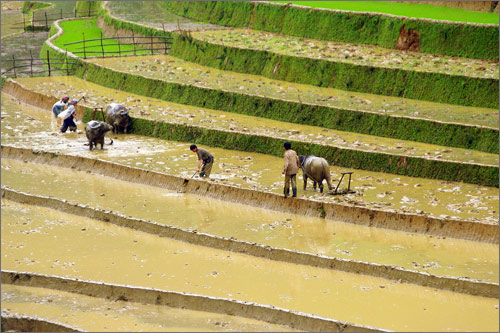
Discover Stunning Terraced fields in Northwest Vietnam

The terraced fields in the mountain district of Mu Cang Chai in Yen Bai, Vietnam are associated with the developmental history of the Mong ethnic minority group.

Khanh Hoa welcomes great number of tourists

Photo: VOV
Over 25,000 tourists flocked to the central province of Khanh Hoa during the first three days of 2011, up more than 20 percent over the same period last year.


According to the provincial Culture, Sports and Tourism Department report, of the total, foreign visitors rose by almost 80 percent. The province’s tourism sector earned VND22 billion in revenues.


On January 4, the Ocean Princess cruise liner from Hong Kong including 750 tourists aboard arrived in Nha Trang Port, marking the start of a high-class international seaway tourism in Khanh Hoa Province this year.

Last year, Khanh Hoa Province welcomed 15 cruise ships with 16,000 foreign tourists.

According to the Culture, Sports and Tourism Department of Khanh Hoa Province, 2010 is the year that Khanh Hoa Province attracted the greatest number of foreign tourists, which reached 390,000, up 30 percent over 2009.


VNN/VOV/VNA

On golden pond

A group of my friends from the US recently travelled to the Cuu Long (Mekong) Delta, home to Tra Vinh's legendary Ba Om Pond. While there, they visited Ang Pagoda which people claim is the best vantage point from which to enjoy the beautiful scenery of the pond.


Tree-lined drive: The Ba Om Pond complex in the Mekong Delta province of Tra Vinh. — File Photos
Located on the outskirts of Tra Vinh Town, the pagoda complex is a fortress that offers travellers an escape from the heat and dust of Road 52.


One of the group, Duong Quang Chan, an overseas Vietnamese businessman, who has lived in the US for years, was returning on this occasion to seek out business opportunities and said he was considering a tourism project in Tra Vinh, which also happened to be his grandmother's birthplace.


"As we arrived at the complex, we were amazed by the century-old trees. From a distance, their strange stumps looked like giant snakes heading for the sky," said Chan.


The soft whispering of the trees combined with the low murmur of Buddhist monks reciting the scriptures from a distant pagoda to create a blissful atmosphere for those wanting to meditate, he said.


A local photographer Huynh Van Hung said that a great flood may have swept through the area long time ago, shaping it and marking the old trees.


Sitting on a hammock strung between two old stumps, Hung said visitors often come here to enjoy the view of peaceful Ba Om Pond, famed for its pure water.


Hung said although visitors have their own camera they still ask him to photograph the view.


Ba Om Pond is called a square pond, but is actually 300m wide and 500m long. The pond is carpeted with water lilies and lotus flowers which bloom white and purple every summer.


The legendary pond was formed as a result of a bet between young ethnic Khmer men and women. The exact date is unknown but according to the elderly monks known by the Tra Vinh Khmer as Luc Masters, the pond was formed about 500 to 600 years ago.


Nguyen Thu Anh, a guide at the Tra Vinh Khmer Museum, said that long ago Khmer society was matriarchal. Young women had to find partners and present betrothal gifts to the bridegroom's family. This habit made the young men selfish and they asked for gifts of ever increasing value.


Fairyland: Ang Pagoda, a marvellous Khmer pagoda, welcomes a million visitors a year.
Tiring of this, leader of a women's group, a lady called Om, sought approval from officials in the region for men to do what women had been doing for centuries. The clever official asked the two groups to dig one pond each. They were to be a kilometre apart. Whoever finished first would be the winner and could ask the other group to do their bidding.


This decision would benefit the entire region, as two big ponds contained a great deal of water, which was much needed in the dry season.


In a story that mirrors the fable of the turtle and the rabbit, the group led by Om pretended that they was not up to the task and tried to shelter from the sunshine. Om responded by asking some of these lazy women to lure the men by holding a party to last all day and night.


While half of her group were busy with the men, the others lit torches and dig all night. Their pond was finished by the next morning and took her name. The unfinished men's pond can still be seen at the site of Pras Tropeang Pagoda.


There is another legend which states that the two are natural ponds and that both were there before the Khmer settled in Tra Vinh. Indeed, many Khmer people still use the name Srar Cu (twin ponds) when talking about the ponds. The name Ba Om (Lady Om) is also one way of pronouncing the name of the vegetable which grows naturally around the pond. The cows in the region love this vegetable, and their flesh is very tasty as a result. Visitors can try this special beef in food stores in the region.


The Ba Om Pond complex was recognised as a national historical-cultural relic in 1996. It is popular site for Khmer festivals, especially the Ok Om Bok, which takes place in the middle of the tenth lunar month. At that time, the Khmer of the entire Mekong Delta gather there to host traditional customs and games.


Dang Phuoc Tho, director of the Provincial Cultural Centre, said the festival was held for people to express thanks to the moon for good weather and a good harvest.


Last lunar month nearly 30,000 local and foreign visitors watched a boat race on the Ba Om Pond as part of this festival. The event attracted 500 boatmen from the province and eight boats competed over 700m and 1,500m.


The boats, called ghe ngo, are pirogues crafted from tree trunks. They have a curved head and tail and are managed by skilful boatmen.


On the night of the festival, family members gather before the communal pagoda or in their houses, preparing a feast with farm produce like green rice flakes which are the speciality of the Khmer people, ripe bananas, fresh coconuts and mangoes. These are all offered to the moon.


As the moon rises, the ceremony begins. Family members sit on the ground, hands clasped. An elderly man expresses the village's gratitude and recites prayers for continued good crops and good health.


After the ceremony, everyone joins hands and looks at the moon. They receive green rice flakes from the elderly man and make a wish. People then release paper lanterns into the sky and banana-tree rafts decorated with colourful lights and loaded with offerings are set adrift on the river.


Tran Hoang Be, director of the Tra Vinh Department of Culture, Sports and Tourism, said the province plans to invest billions of dong to expand the Ba Om Pond culture-tourism complex to 84ha. It will include a Khmer museum, a sports centre, a service-trade and a tourism centre.


The aim is to attract more visitors to the area by preserving and improving the site's original landscape, said Be.

The site welcomes millions of visitors every year.


VietNamNet/Viet Nam News

Vietnam welcomes first foreign visitors for 2011

Hundreds of visitors from many countries were warmly welcomed at the Noi Bai and Tan Son Nhat International Airports in the morning of January 1 2011.

From the early morning, officials of the HCM City Department of Tourism were at the Tan Son Nhat Airport to welcome 160 visitors from Taiwan on a flight of Vietnam Airlines, who arrived at the airport at 9.30am.

Not so long after that, 300 visitors from the US, Britain, France and the Netherlands arrived at the airport from a flight from Hong Kong.

Welcomed by flowers, gifts and congratulations from tourism officials as well as traditional dances and songs, many tourists were very surprised.

“Friendly and thoughtfully welcoming is the way we impress international visitors and improve the images of HCM City and Vietnamese people in the eyes of international friends,” said HCM City Department of Tourism’s deputy director La Quoc Khanh.

The same day, Vietnamese airlines and travel firms welcomed their first foreign visitors.

Saigontourist welcomed a group of eight Australian visitors at the Noi Bai airport. They came to Vietnam for a 17-day tour. On December 31, Saigontourist also greeted 750 visitors in a cruise ship named Europa in Ha Long.

Vietravel also welcomed its first 27 foreign visitors of 2011 from Italy, who will travel Saigon – Phu Quoc – Hoi An – Hue – Hanoi – Ha Long – Sapa within 13 days. Vietravel organized a special New year party on Phu Quoc Island for them.

Welcoming the first foreign visitors was the first event of many in the tourism sector to advertise the image of Vietnam in 2011.

PV

Work starts on eco-village

A project to build an eco-village in Tien Chuong Commune in the central province of Ha Tinh to prompt increasing awareness of the need for environment protection started yesterday, Dec 29.


Jointly launched by Toyota Viet Nam (TMV) and the Viet Nam Environment Protection Agency (VEPA), the project also aimed to help local people learn how to preserve natural resources for sustainable development, said organisers.


The VND800 million project, funded by TMV, will include different training courses on environmental hygiene and how to use safe water in an effort to improve community health.


"Local people will also be trained to improve infertile soil and develop eco-systems along and around their fields; new cultivation methods and how to use suitable fertilisers and pesticides," said Akito Tachibana, general director of TMV.


He said local people would be supplied with 200 books guiding them on how to deal with waste around their homes and community and protect safe water resources.


Last year, a similar project was launched in An San Commune in the north-western province of Lao Cai's Bat Xat District, benefiting some hundreds of local people on how to improve their living standards.


The projects are as part of the major Go Green Programme jointly held by the TMV, the VEPA and the Ministry of Education and Training since 2008.


VietNamNet/Viet Nam News

Literature Temple In Hanoi

The Temple of Literature is one of the most popular landmarks of Ha Noi (Pho Quốc Tử Giám, Tel 845 2917, admission 5000 Dong). The term “temple” may mislead a lot of people into believing the complex is a religious site.
Văn Miếu, in fact, is a Confucian memorial place dedicated to the centuries of education and literature in Vietnam. Founded in 1070 by King Ly Thánh Tông, the temple was built to pay tribute to the Chinese philosopher Khong Tu (Confucius), his scholars and people with high academic achievement. In 1076, the Quốc Tử Giám (or Imperial Academy) was founded. As Vietnam’s first university, it was initially opened to educate the aristocrats, nobles and royal family members. In the later years, the school was opened to talented commoners. In old Vietnam society, Si (literary bureaucrats and scholars) were given the highest regard. Below them in the social ranking are the Nong (farmers), Cong (craftsmen and workers) and Thuong (merchants). Functioned within 1076 to 1779, Văn Miếu was the only place where mandarin class was taught. Through its history, over two thousand doctors have graduated from the university. Known as "pagode des Corbeaux" during the French colonization, the whole of Văn Miếu encompasses a profound traditional meaning of both a Confucian temple and the first imperial university of Vietnam.

The long narrow complex consists of five courtyards lined out in order and divided by walls. The first area is the entrance where the main gate (Văn Miếu Môn) with two stone dragons stands. On it, the inscription “Ha Ma” reminds visitors of former times, regardless of their social ranking, to dismount their horses before entering Văn Miếu. As the entrance leads to three pathways running the length of the complex, the center path heads straight through another gate to the second courtyard indicated by two small gates on both sides. Here, its main course leads to Khuê Văn Các (Pavilion of Literature) and two other small gates on its side. These first two courtyards are basically quiet and serene exuding a peaceful haven with its well-trimmed lawns and grown trees providing suitable shade to the garden’s entirety.

The third courtyard separates the Khue Van area from the Gate of Great Synthesis (Đại Thành Môn). A square lake, the Well of Heaven’s Clarity (Thien Quang Tinh), sits at the center of the courtyard and is surrounded by walls. On both sides of the lake are pavilions with stelae, each sits upon stone tortoises and holding inscriptions of names, birth places and achievements of doctorate recipients from periods 1442 to 1780, where the Vietnam capital was moved to Hue. There are 82 stelae presently standing in Văn Miếu, where some 34 others are believed to have been lost over the years.

The entrance of the fourth courtyard from the latter directly faces a pavilion, named the Great House of Ceremonies, where a large red lacquered statue of Confucius stands. Bordered on either sides are two great pavilions which used to host alters of 72 of Confucius’ greatest students. Now, the buildings house several gift shops, souvenir item displays and a museum. In the fifth courtyard (Thai Hoc) stands the Quốc Tử Giám, Vietnam’s first university founded in 1076 King Ly Can Duc, but this was destroyed by French bombing in 1947.

Having gone through several destructions and restorations, the Temple of Literature still retains its original features. Signifying a hallmark of education in ancient Vietnam and its great value to the Vietnamese people, the longevity of the temple and its structure is astounding. A place worth-exploring, Văn Miếu is not just among the finest historical and cultural sites in Hanoi, but in the whole Vietnam as well.

(Source: vietnam.com)


TEXT LINK:
tải game điện thoại - Agents for modeling - Gai xinh - Visa Vietnam - Vietnam Express Visa - Teen Teen - Tai iOnline Mien Phi - Game Java